Boiler Room to Boardroom: The Quiet Renaissance of Steam in American Industry
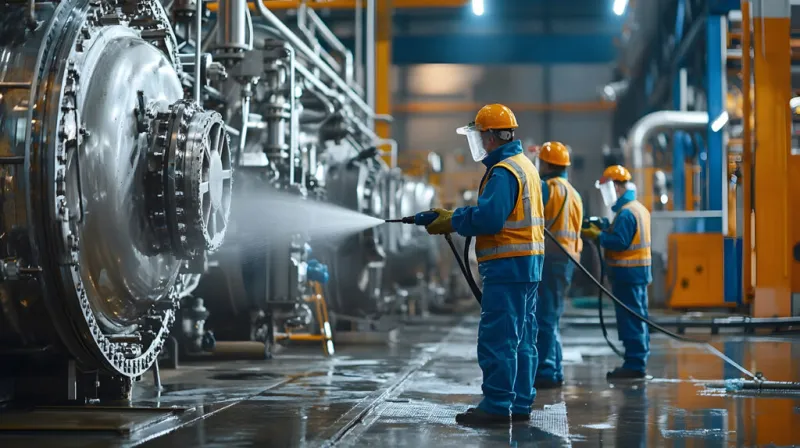
Photo: industrial steam cleaning equipment factory worker professional, via intelligent-fluids.com
Every technology has an arc, and few arcs are as long as steam's. It drove the mills of Lowell, heated the Pullman cars, and sterilized the canneries that fed a growing nation. Then, somewhere in the postwar decades, steam receded — still essential, but unglamorous, relegated to boiler rooms and the men who understood them. What's remarkable about 2024 is not that steam is new. It's that steam is back in the room where budgets are set.
A Brief History of Doing Things Properly
The industrial logic of steam has never really changed. Water heated past its boiling point carries enormous energy and releases it on contact — cutting through grease, killing pathogens, and stripping residue without the solvents that later generations substituted for it. Nineteenth-century engineers grasped this immediately. What they lacked was portability, precision control, and the ability to document what the steam actually did.
Modern steam technology solved all three. Today's systems deliver calibrated temperature and pressure to a shipping container, a production line, or a food-grade facility — and log every degree of it. The heritage tool became a measurable one.
Why the C-Suite Started Paying Attention
Three converging pressures explain steam's executive-level revival.
The sustainability mandate. Corporate ESG commitments have put chemical usage under scrutiny that no facilities manager can ignore. Steam cleaning replaces a shelf of petrochemical solvents with water and heat. For companies with public emissions and chemical-reduction targets, that substitution shows up directly in sustainability reporting.
The sanitation imperative. Regulatory expectations for imported and exported goods — FDA, USDA, and the phytosanitary standards of trading partners — have tightened steadily. Heat-based treatment is among the few methods that satisfies multiple regulatory regimes at once, and modern verification systems produce the audit trail that compliance teams used to build by hand.
The arithmetic. Disposables, chemical procurement, wastewater handling, and the labor of multi-pass manual cleaning add up to more than most organizations realize. When companies actually run the numbers, steam's operating economics frequently win — particularly at volume, where the per-unit cost of container or equipment treatment drops sharply.
From Maintenance Line Item to Strategic Capability
The most interesting shift, though, isn't cost. It's positioning. A generation ago, industrial cleaning was something you did because you had to. Increasingly, American manufacturers and exporters treat verified steam sanitation as a market-facing asset — a certification that travels with the shipment, reassures an overseas buyer, and differentiates a bid in a crowded procurement process.
That is the real meaning of the journey from boiler room to boardroom. A technology that once answered the question how do we keep the equipment running? now answers a different one entirely: how do we prove, to any customer and any regulator on earth, that our goods are clean?
Heritage Is Not the Opposite of Innovation
There is a lesson here for how American industry thinks about its tools. The newest solution is not always the one invented last decade. Sometimes it's the one that has been quietly working for a century and a half, waiting for measurement, sustainability pressures, and global trade standards to catch up to what the boiler room always knew.
Steam didn't need to be reinvented. It needed to be recognized. The companies doing that recognizing first are finding that the oldest industrial technology on the floor has become one of the freshest arguments in the boardroom.